


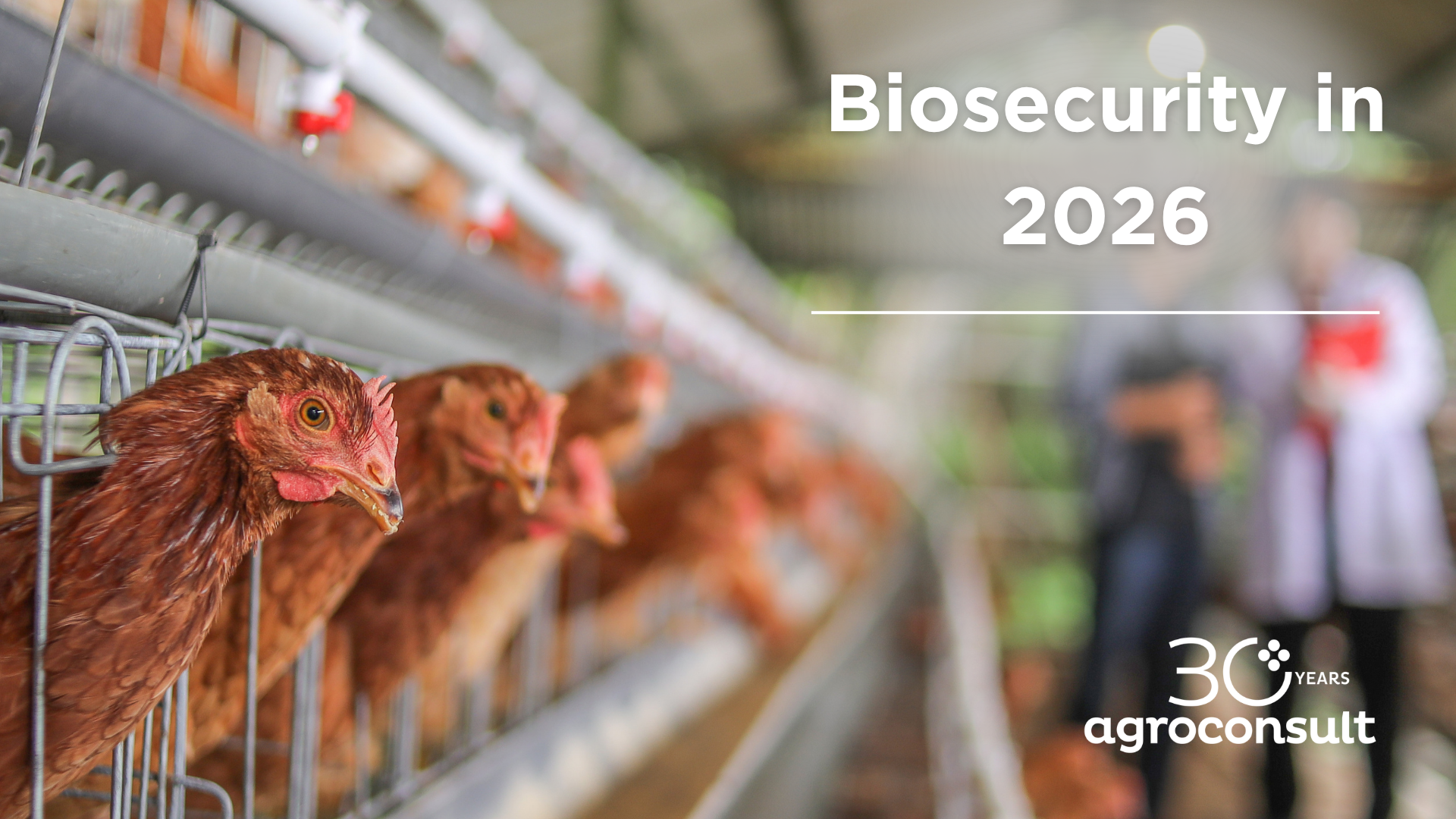
Avian influenza is once again a major threat to Europe’s poultry sector. How did we get here, and what can you do to protect your poultry farm?
During the 2025/2026 season, Europe experienced another severe wave of highly pathogenic avian influenza (HPAI). Between 6 September and 28 November 2025, 2,454 HPAI outbreaks in wild birds were reported across 29 European countries—an unprecedented number for this time of the year. According to EFSA, indirect contact with wild birds was most likely the source of infection in the majority of outbreaks affecting domestic poultry.
The issue has become so important that, in May 2026, the World Organization for Animal Health (WOAH) adopted a new stand-alone international standard on biosecurity. This is a clear sign that biosecurity is becoming an increasingly important part of risk management in livestock production.
But what does this mean in practice for a poultry farm? Here are five essential measures you can implement to reduce the risk of infection:
1. Strictly control everything entering the farm
People, vehicles, tools, equipment and materials can introduce pathogens into the production area.
Restrict access to poultry houses to essential personnel only. Keep a visitor log, provide appropriate protective clothing and footwear, and consistently follow established cleaning and disinfection procedures.
Fewer unnecessary contacts mean fewer opportunities for pathogens to enter the farm.
2. Break the transmission pathway between wild birds and your farm
This is one of the most important aspects of avian influenza prevention.
Prevent any contact between wild and domestic birds. Regularly inspect nets, openings and the structural elements of poultry houses. Do not leave feed or water accessible to wild birds.
The area surrounding the poultry farm must also be properly managed, including vegetation, standing water, waste and any other features that may attract wild birds or pests.
3. Do not underestimate rodents and insects
Effective biosecurity begins outside the poultry house. Rodent and insect control are not mere formalities—they are integral parts of day-to-day biosecurity.
Control feed spills, waste and access to water. Keep poultry houses and the surrounding areas in good condition and carry out regular maintenance.
4. Monitor your birds and respond immediately to any abnormalities
Early detection is the first step towards a rapid response. WOAH identifies early detection as a key element in the effective control of avian influenza. Changes in water or feed intake, behaviour, mortality rates, productivity or egg quality may be early warning signs of a problem.
Monitoring and tracking key performance indicators should therefore be part of the daily routine. A rapid response and a clearly defined action protocol are essential for every modern poultry farm.
5. Make automation part of your biosecurity strategy
Automation does not replace good hygiene practices. However, it can reduce the number of manual operations and provide more consistent control over the production environment.
Automated feeding and drinking systems, ventilation, heating, cooling and poultry house climate control enable more precise management of environmental conditions.
If temperature, humidity or other predefined parameters deviate from their target ranges, the system can issue an alert, allowing farm personnel to respond quickly.
Biosecurity begins at the design stage
A well-protected poultry farm requires much more than simply using additional disinfectant.
The farm layout, the movement of people and vehicles, ventilation, feeding and drinking systems, manure management, access to poultry houses and automation must all be planned as one integrated system from the very beginning of the project.
This is where the role of an experienced poultry farm design and equipment partner becomes essential.
Agroconsult – extensive experience, high-quality equipment at competitive prices, and installation and service you can rely on
At Agroconsult, we have 22 years of experience in the planning, supply, installation and maintenance of poultry farming equipment. We work on projects of varying scale and complexity throughout Bulgaria.
As a partner of leading European poultry equipment manufacturers, we can provide solutions tailored to the specific requirements of each facility and its production objectives.
Our equipment is supported by a team of installation specialists with extensive hands-on experience and a reliable after-sales service team that remains available long after the project has been completed. Effective biosecurity is not a one-off measure. It is a system that must work every single day.
Do not wait for the problem to reach your farm. Prepare with Agroconsult by following internationally recognised best practices.
Contact the Agroconsult team for a consultation and a solution tailored to your farm.
+359 885 563 878 | office@agroconsult.bg


